Factsheet
What FlashBoss is
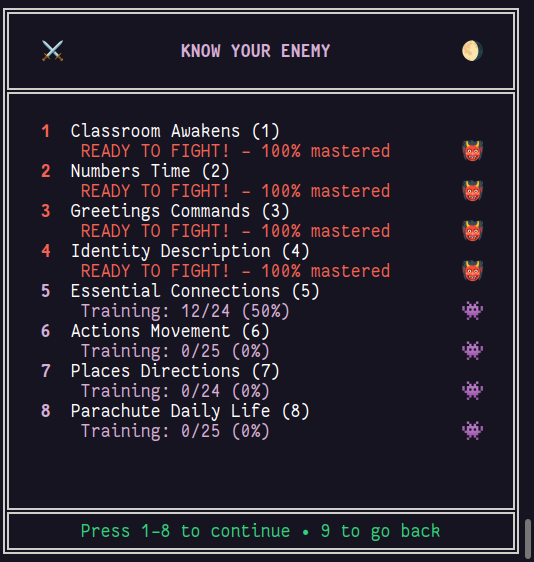
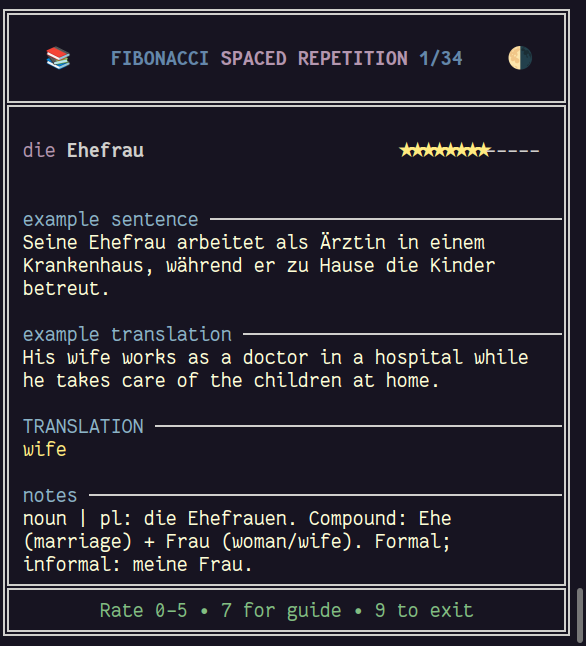
FlashBoss is a desktop terminal application for vocabulary acquisition. A spaced-repetition scheduler deals cards; each card carries a target word, a constructed example sentence built only from vocabulary already introduced, translations, optional study notes, and text-to-speech on the target-language fields. Cards are grouped into themed clusters, and no cluster leaves rotation until it is beaten in a boss fight.
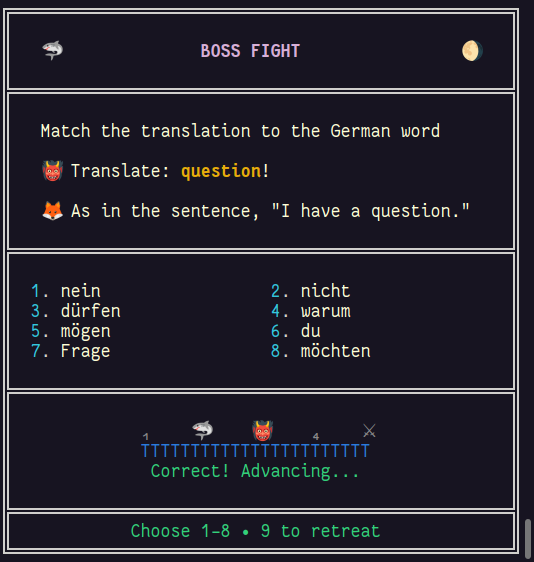
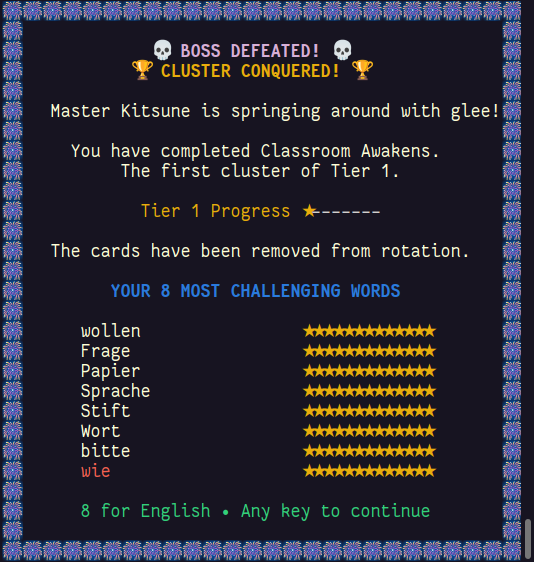
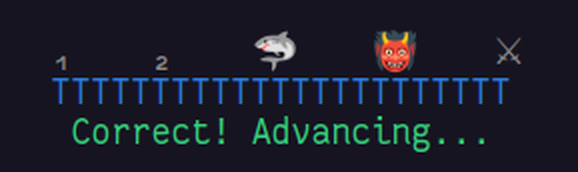
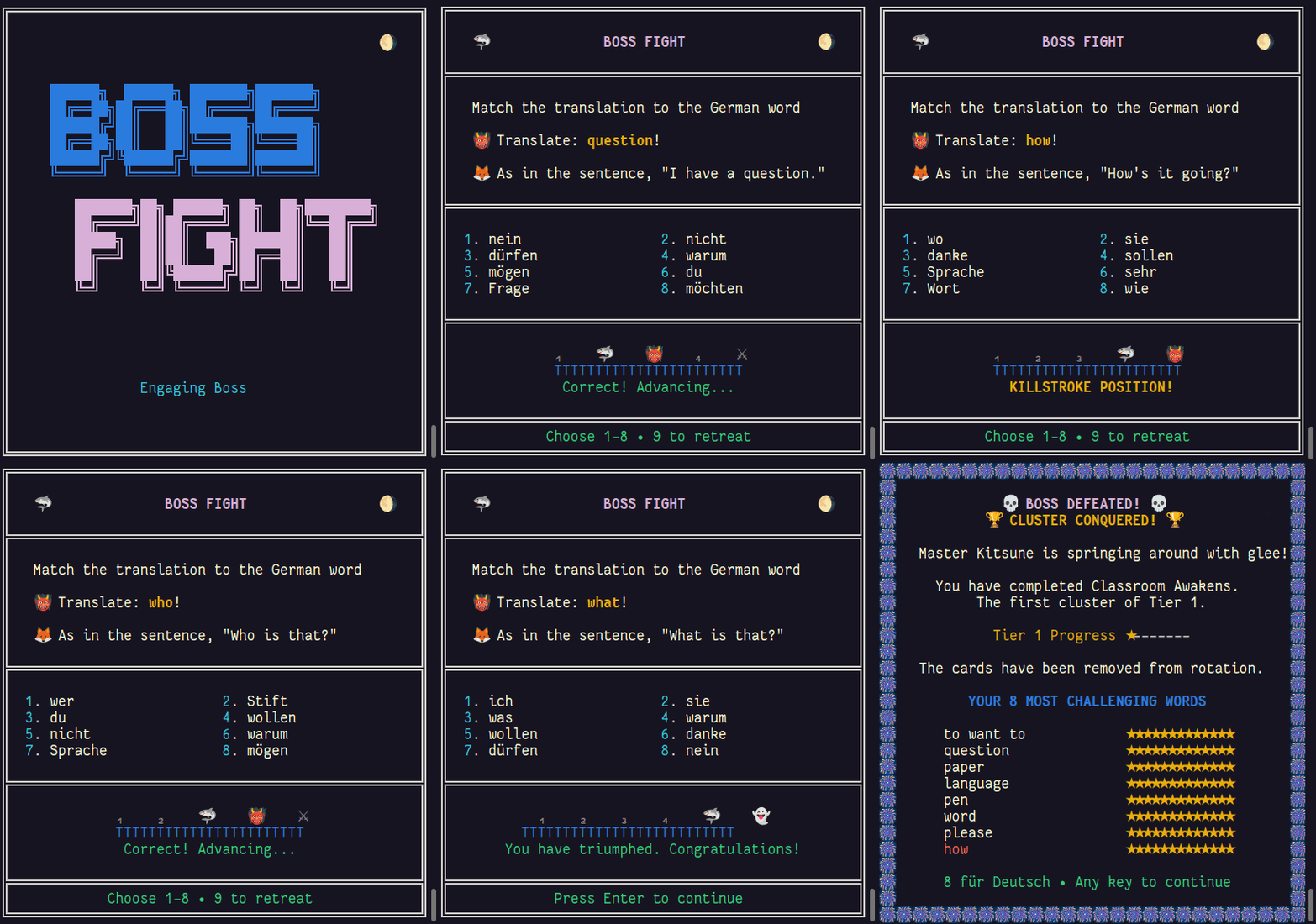
The boss fight is the graduation mechanic and the part worth filming. Learner and boss share one linear track: a correct answer advances the learner a step and shoves the boss a step toward the far edge, a wrong answer slides the learner two steps back. Positions 1 and 2 deal the cluster's easiest cards; positions 3 and 4 deal its hardest — so a cluster cannot be conquered until its weakest words are answered.
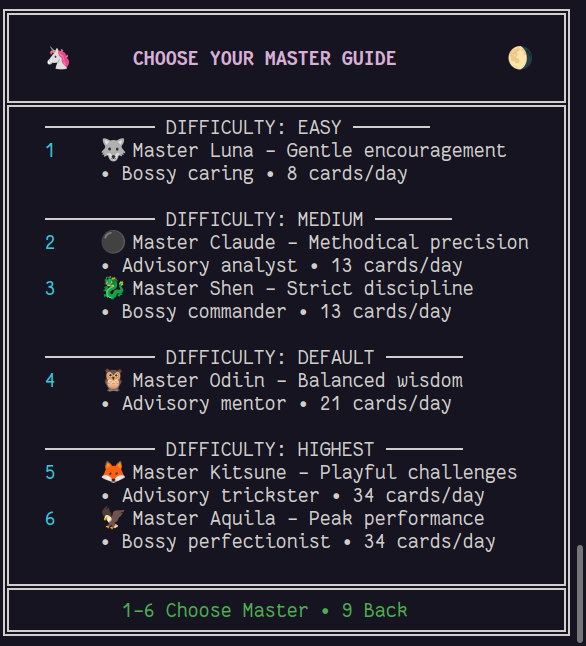
Six masters set the daily pace, from 8 cards a day to 34 — roughly five to thirty minutes. Ratings move cards along a Fibonacci interval sequence, and a cluster becomes eligible for its fight once 80% of its cards reach the 13-day interval. The full mechanical reference, with citations, is on the How FlashBoss Teaches page.
The catalogue
Twenty-three packs are released and playable today. Card counts below are the shipped totals.
Free in the base game
| Pack | Cards | What it teaches |
|---|---|---|
| English Advance | 500 | The practical English of adult life — forms, letters, officialdom, the small print. |
| English Adept | 1,000 | The articulate vocabulary of an adult reader, grouped by what it does, with synonyms on all 1,000 cards. |
| German Core | 1,000 | The first 1,000 words of German, with a cultural integration section. |
| Esperanto Core | 1,000 | The first 1,000 words of Esperanto. |
| Toki Pona | 500 | The complete course in the world's smallest language. |
The Roots series — English vocabulary through etymology
Paid DLC, taught entirely in English, five tiers each. Cards give a definition and worked examples rather than a translation — card text stays English whatever the interface language, which is what the word immersion is doing here. The four sit on one path with English Advance and English Adept: the English immersion system.
| Pack | Cards | What it teaches |
|---|---|---|
| German Roots | 1,000 | The Germanic backbone of everyday English — 47 clusters, 48 lessons. |
| Norman Roots | 1,000 | The French that arrived in 1066 and stayed — 48 clusters, 49 lessons. |
| Latin Roots | 500 | The classical and scientific layer, assembled from its parts. 500 cards teach 1,000 words — a paired cousin on every card — in 30 clusters, 31 lessons. |
| Greek Roots | 1,000 | The vocabulary of science, medicine and philosophy, with the Greek script on every card — 56 clusters, 62 lessons. |
English as a foreign language
Paid DLC, and the one course that is never taught through English: every card carries its translation, its translated example sentence and its study notes in German, Spanish, Japanese, Simplified Chinese and Russian.
| Pack | Cards | What it teaches |
|---|---|---|
| English Core | 1,000 | The highest-frequency thousand words of English, five tiers and 38 reference lessons. |
| English Pareto 1 | 1,000 | The next thousand by frequency — the second half of everyday English. |
| English Pareto 2 | 1,000 | The third thousand: formal connectors, abstraction and register. |
Foreign-language courses
Each full course runs Core → Pareto 1 → Pareto 2, cumulatively: 3,000 cards across tiers 1–15, an A1–C1 arc. Example sentences in each pack are built from the vocabulary of the packs before it.
| Course | Cards | Released packs |
|---|---|---|
| German | 3,000 | Core free · Pareto 1 · Pareto 2 |
| Spanish | 3,000 | Core · Pareto 1 · Pareto 2 — Latin American |
| Italian | 3,000 | Core · Pareto 1 · Pareto 2 |
| Esperanto | 3,000 | Core free · Pareto 1 · Pareto 2 |
| French | 3,000 | Core · Pareto 1 · Pareto 2 |
| Latin new | 2,000 | Core · Pareto — a reading course, ten tiers, grammar-complete |
| Swahili new | 1,000 | Core — Pareto 1 and Pareto 2 written, not yet released |
Every card in every course above carries its translation and its study notes in German, Spanish, Japanese, Simplified Chinese and Russian as well as English — except where one of those is the language being taught. Latin is a reading course rather than a Core-to-Pareto-2 staircase: Core and Pareto together are the whole 2,000-word trunk, and it forks after that rather than continuing. Ancient and Modern Greek are in production; the In Development page tracks what is coming.
Not a language — The Guide
Paid DLC. A rules set drilled the way a vocabulary is: the terms, numbers and procedures a tabletop game master is expected to know without stopping to look them up. 5E compatible, built from the System Reference Document 5.2.
| Pack | Cards | What it teaches |
|---|---|---|
| The Guide new | 1,205 | 62 clusters, 62 reference lessons. A full German edition; Japanese, Simplified Chinese, Russian and Spanish play in that language and answer in English. |
Voice DLC
A voice DLC replaces the included voice across every pack in that language — cards, lessons, boss fights — and can be switched back at any time. Each is on the voices page, playing against the voice it replaces.
| Voice | Replaces | Across |
|---|---|---|
| British English (female) | the included American voice | every English pack |
| Castellano (Spain, male) not yet released | the included Latin American voice | every Spanish pack |
Interface and audio
Six interface languages
The whole game — menus, lessons, boss fights, achievements, the masters' own dialogue — runs in English, German, Spanish, Japanese, Simplified Chinese and Russian. The first launch asks which; Ctrl+L switches at any moment, from any screen. Interface language and card language are chosen independently, so the German course can be studied through Japanese while the menus stay in Spanish.
English text is American by default, with a per-hero British spelling layer covering cards, lessons, cluster names and answer checking.
Text-to-speech
Audio is generated by the neural text-to-speech engine the game ships with (piper1-gpl, GPL v3; the corresponding source is included with the game). It is not recorded human voice, and it is not locked to the cards: Ctrl+P opens a pronounce window that will speak or save any text you paste into it, in any installed language.
Accessibility — please report these accurately
- Type size is not adjustable in-game; it follows the terminal.
- The game does not support screen readers.
- The pronounce window is mouse-driven.
- Windows 10 needs Windows Terminal (a free Microsoft Store download). A numeric keypad is recommended on every platform.
Copy templates
Lift these verbatim or adapt them — no attribution needed.
Spaced repetition with boss fights — a vocabulary course that fights back.
FlashBoss is a terminal vocabulary trainer: spaced repetition, example sentences built only from words you already know, text-to-speech on every target word, and a boss fight at the end of every cluster. Five packs ship free. One-time purchase, no subscription.
FlashBoss is a desktop vocabulary trainer that hides a serious spaced-repetition course inside RPG armour. Cards arrive in themed clusters, each target word set in a sentence built only from vocabulary already taught, spoken aloud by the game's neural text-to-speech engine. No cluster leaves rotation until you beat its boss — and the fight deals your weakest words first. Twenty-three packs are out, from full 3,000-word courses in German, Spanish, Italian, Esperanto and French to English etymology through its Germanic, Norman, Latin and Greek roots. It runs in English, German, Spanish, Japanese and Simplified Chinese.
FlashBoss is made by Odiin, a solo developer based in Germany, who built it out of his own frustration at knowing thousands of German words he could not use with confidence. It runs on Windows, macOS and Linux via Steam.
Self-directed language learners; Anki users who want structure, a syllabus and a reason to come back; readers building English vocabulary for study or work; and anyone who likes a terminal and a low-distraction study tool that runs on almost any machine.
Every example sentence is constructed, not scraped, so the target word is usually the only unknown on the card. Progress is gated: a cluster is conquered by defeating a boss with your hardest cards, not by clicking through a queue. And the whole thing runs in five languages, so the course does not have to be studied through English.
Screenshots and assets
Right-click to save. These are the current build; for the full boss-fight sequence, localized screens, or anything at a different size or format, email and ask.
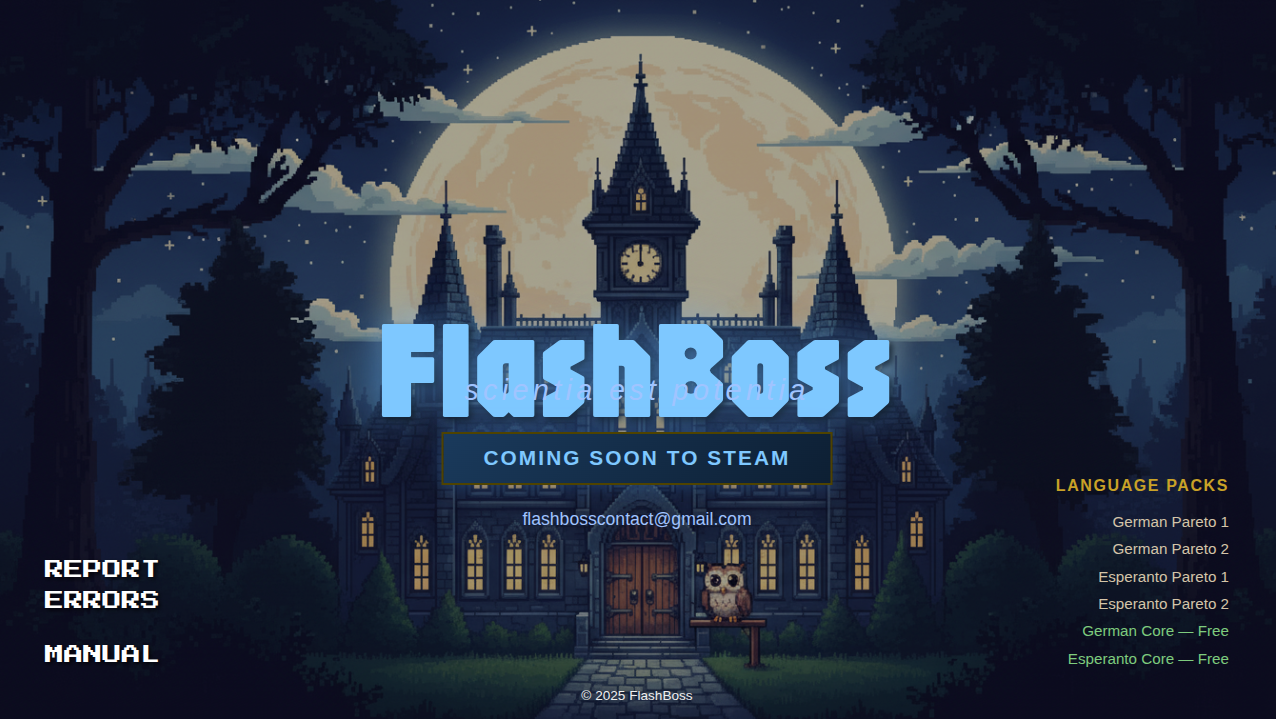
Free to browse and equally free to screenshot: the complete word lists and every reference lesson for all packs, DLC included, plus the playable boss-fight demo, which runs in a phone browser.
Press and affiliate FAQ
Yes. Email flashbosscontact@gmail.com with a link to your channel, publication or platform.
Yes, on the Steam page. Ask if you need the raw file.
The boss-fight demo is playable in any browser, and the full word lists and lessons for every pack are published on this site. Five packs are also free inside the base game.
Register a Steam UTM link and you are paid a flat $0.50 (USD) on every sale Steam attributes to it. Full terms, thresholds and payout timing are on the promote page.
No. The base game is bought once and the packs are bought once. There are no accounts and no recurring charges.
No, and the developer says so on the record. FlashBoss trains reading, listening and recognition — the input half. Speaking and writing practice is left to conversation classes, tutors and other tools.
No. All audio is text-to-speech, generated by the neural engine bundled with the game. Please do not describe it as native or recorded voice.
Contact
Review keys, interviews, asset requests, fact-checks, corrections: flashbosscontact@gmail.com.
If a number in your piece needs confirming before it goes out, ask — a wrong count is worse for both of us than a slow reply.