Base game · included free
Learn toki pona with FlashBoss
A whole language. Around 140 words.
Listen · Read · Repeat · Rate · Fight
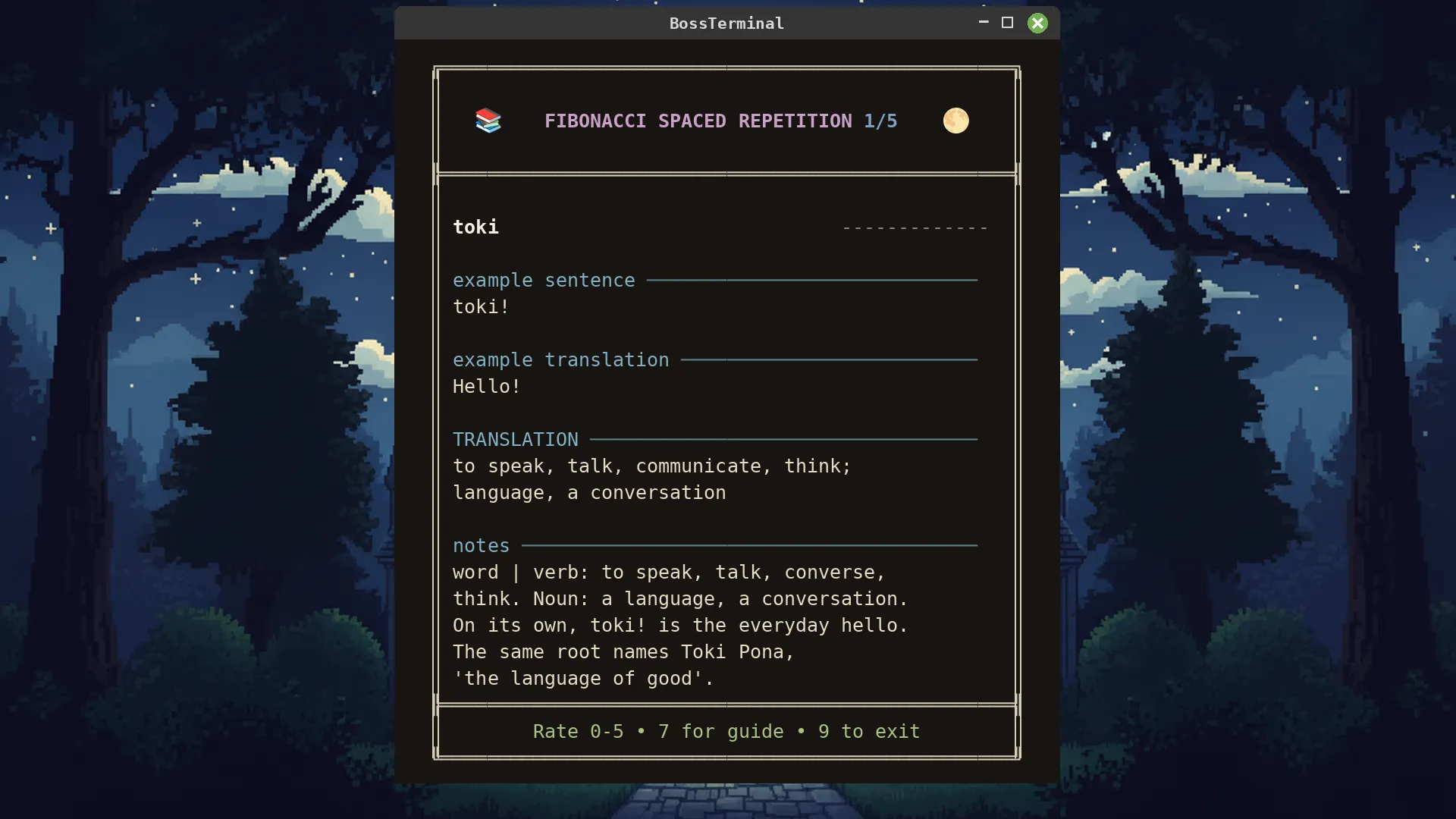
You begin with toki! — hello. Five hundred cards later there is nothing left of the language to meet. Free, inside the base game.
The whole language, not a slice
toki pona — the language of good.
Toki Pona is a constructed language built as an experiment in minimalism: around 140 words, and a question underneath them — how much can you say with almost nothing? There are no tenses to conjugate, no genders to memorise, no irregular anything. Spelling is phonetic: say what you see, and you have said it right.
What is left is combination. tomo tawa, a moving structure, is a car. ilo toki, a talking tool, is a telephone. And because the vocabulary is so small, each word has to stretch: pona is good, simple, useful and kind at once. You stop reaching for the exact word and start deciding what you actually meant — which is the point of the whole exercise.
Most languages are too big to finish. This one is not. FlashBoss teaches all of it in 500 cards across 22 clusters and 5 tiers: 178 single-word entries — every content word and every grammar particle the course teaches, the book vocabulary plus the community words that have earned their place beside it — 250 compound phrases, and 72 sentences built from them.
First words, people and pronouns, good and bad, wanting and coming.
Work and origins, feelings and food, home and tools, giving and playing.
Sleep and sunlight, ways and books, numbers and money, sound and community.
Death and cycles, sky and air, body and darkness, heat and plants, fruit and family.
Moons and clothing, colours and creatures, birds and beasts — and the bonus words.
Five tiers, twenty-two clusters
Each cluster ends in a boss fight. Beat it and those cards leave your daily deck for good.
| Tier | Clusters | Cards | What you meet |
|---|---|---|---|
| Tier 1 | 4 | 86 | The first words, people and pronouns, good and bad, wanting and coming. Seven grammar lessons land here — you are making sentences on day one. |
| Tier 2 | 4 | 91 | Work and origins, feelings and food, home and tools, giving and playing. |
| Tier 3 | 4 | 91 | Sleep and sunlight, ways and books, numbers and money, sound and community. |
| Tier 4 | 5 | 114 | Death and cycles, sky and air, body and darkness, heat and plants, fruit and family. |
| Tier 5 | 5 | 118 | Moons and clothing, colours and creatures, birds and beasts, and two clusters of bonus words from beyond the book. |
| Total | 22 | 500 | One pack, the complete language — and more than 2,800 words of Toki Pona read in context. |
Progressively more challenging
The example sentences increase in complexity tier by tier.
- mi jan pona sina.I am your friend.
- sina wile e pona la, sina o pali.If you want good things, you should work for them.
- jan pi sona pona li toki e nasin pona tawa jan lili.The wise person teaches the good way to children.
- jan sona li sona e ni: ona li sona ala e ale.A wise person knows this: they don't know everything.
- telo li tawa anpa lon nasin ale.Water always flows downward, whatever the path.
Two small words, one new one
There are no genders to colour-code here — so FlashBoss shows you the thing that actually matters. A modifier always follows the word it modifies, and the pair means something neither half does alone. Two hundred and fifty cards in this pack are exactly that.
A handful of words that carry the rest
Four cards from the pack. Tap to flip.
Thirteen lessons, each at its own door
No grammar chapter to wade through first. Every particle gets a lesson, and that lesson fires at the exact card where the particle first appears — so you read the rule the moment you need it, and never before.
- 00Welcome to Toki Ponafires at toki — card one
- 01mi / sina need no ‘to be’fires at mi pona
- 02li — the is/does linkfires at jan
- 03o — commands and callsfires at o
- 04pi — grouping modifiersfires at pi
- 05Modifiers come afterfires at jan pona
- 06Asking questionsfires at seme
- 07Preverbs tint the verbfires at wile
- 08la — setting the scenefires at ken la
- 09e — marking the objectfires in tier 2
- 10Numbers, few coloursfires at wan
- 11Six small prepositionsfires at poka
- 12nasin, pu and kufires at ku
You don't have to come through English
Every card carries its translation, its example translation and its notes in all six languages — and so does every one of the 13 lesson pages, and the interface around them. Set your language once, and the whole pack follows.
It costs nothing
There is no Toki Pona DLC. There is nothing to add to a basket.
Toki Pona ships inside the base game, alongside the other free packs. Install FlashBoss, choose it from the language list, and start. It has no prerequisite pack either — run it beside your main language, or on its own.
Flashcards as an integrated system
- Fibonacci SRS
- Rate each card 0–5. The better you know a word, the longer before it returns — spaced repetition on Fibonacci intervals.
- Boss fights
- Each of the 22 clusters is gated by a duel you can't win without confronting and overcoming your most difficult words.
- Graduation
- Beat a cluster and its cards leave your daily deck for good. The deck gets smaller as you learn.
- Compounding
- Half the pack is compounds. Every content word you learn multiplies, because the next 250 cards are built out of words you already have.
- Lessons
- Thirteen reference lessons, each triggered at the card where its particle first appears.
- Text-to-speech
- Cards can be heard. Toki Pona is spoken by the game's neural text-to-speech engine, piper1-gpl, using the pack's native Esperanto voice — chosen because that voice was trained on exactly the phonemes Toki Pona uses, so all fourteen of its sounds come out as themselves, with the penultimate stress the language expects. It is synthesised speech, not a recording of a speaker.
Before you start
Is Toki Pona really free?
Yes. It is one of the packs inside the base game — there is no Toki Pona DLC to buy, and no upgrade behind the later tiers. All 500 cards and all 13 lessons are there from the first launch.
What exactly is in the pack?
500 cards over 22 clusters and 5 tiers: 178 single-word entries — every content word and every grammar particle the course teaches — plus 250 compound phrases and 72 whole sentences. You can read the entire word list before you start, on the word lists page.
Does it cover the community vocabulary as well as the book?
It does. The spine is the book vocabulary, and tier 5 carries the later words that stuck — kijetesantakalu, tonsi, misikeke — before closing on two clusters of bonus vocabulary from further out still: majuna (old), linluwi (a network), isipin (to ponder), nimisin (a new or joke word). The final lesson explains the difference between pu and ku, so you always know which room you are standing in.
Do I need to know English to use it?
No. Cards, lessons and the interface all run in English, German, Japanese, Spanish, Simplified Chinese and Russian. Every one of the 500 cards carries its translation, its example translation and its notes in all five, and all 13 lessons exist in all five.
Where does the grammar come in?
At the door. There are 13 lessons and each one fires at the exact card where its particle first turns up — li arrives with jan, pi with pi, la with ken la. Eight of them land in tier 1. You can also read them all in advance on the lessons page.
Can I hear it?
Yes — through text-to-speech, not a recorded voice. Toki Pona has fourteen sounds and the pack speaks them through FlashBoss's native Esperanto voice, whose phoneme set covers all fourteen exactly, with the penultimate stress the language expects.
Do I have to finish another pack first?
No. Toki Pona has no prerequisite. It is a standalone course, and small enough to sit alongside whatever you are already learning without taking the room.
Take the whole language
Toki Pona is included in the base game. Nothing to buy, nothing to unlock.
Get FlashBoss on Steam →